
How to Choose Your First Music Stand: Height, Desk Size, and Stability
Your first music stand looks like a simple purchase: a metal column, a folding desk, three legs. Then you get it home, open a method book, and discover the desk sits just below your line of sight, the clamp slides under the weight of a thick binder, and the whole thing shivers every time you turn a page. None of that is bad luck. It is what happens when a stand is chosen from a photo instead of from your own playing position.
Three things decide whether a stand will serve you well: how high it goes and how firmly it holds there, how much music the desk actually carries, and whether the base stays put when you lean on it. Everything else — finish, folding mechanism, brand — is detail. Useful detail, but detail.
Start With Where the Desk Needs to Sit
Before you look at any stand, sit in the chair you normally practise in and look straight ahead. The centre of the page should land at roughly eye level or a little below it, so your eyes move without your head dropping. For most seated players that puts the middle of the desk somewhere around chest to shoulder height, with the bottom edge of the desk clear of your knees and your instrument.
If you play standing — flute, violin, brass, or a mix of both — measure that position too. Stand as you would in a rehearsal, hold your instrument, and note where a page would need to be. Many players practise seated at home and perform standing, which means the stand has to work at two different heights. Write both numbers down. They are the most useful measurements you will take all day.
One more thing belongs in that note: the surface under the stand. A carpet swallows a fraction of an inch of height and lets legs sink unevenly; a wooden floor does not. If you will use the stand in both places, buy for the softer floor and accept a slightly taller stand on the hard one.
Height Range: The Spec Sheet Only Tells Half the Story
Manufacturers list a minimum and maximum height, and beginners tend to read only the maximum. That is backwards. What matters is whether the stand holds firmly at the height you need, especially if that height is near the top of its range. A stand that extends to a generous height but wobbles once it gets there is less useful than a shorter one that locks tight at the height you actually use.
Look for a telescoping column with at least two locking points, and check how the lock works. Knurled knobs are easy to grip and easy to replace if they work loose. Lever clamps are faster but can lose tension over time. Either is fine; a friction collar with no positive lock is not.
The five-minute fit test
- Set the column to your seated height and tighten it fully. Press down on the centre of the desk with your palm. The column should not slide down by even a centimetre.
- Load the desk with the heaviest thing you realistically use — a ring binder, a thick anthology, a tablet in a case — and tilt the desk back to a comfortable reading angle.
- Turn two pages in a row, a little faster than you normally would. If the whole stand rocks, the problem is the base. If only the desk dips, it is the tilt joint.
- Stand up and raise the stand to your standing height without taking the music off. Stiff knobs and sticky joints get worse over time, not better.
- Flatten the desk as far as it goes and check that it holds. A shallow angle is right for reading; near-flat is what you need for pencil marks and for writing in fingerings.
If you can do this in the shop, do it. If you are buying online, look for a stand whose stated range comfortably brackets your number rather than just reaching it — roughly a hand's width of adjustment above and below your ideal height is a good buffer.
Desk Size: Measure What You Actually Put On It
A standard open sheet of music is about 42 cm wide when the two pages sit side by side, and around 30 cm tall. That is your floor, not your target. Add a ring binder, a method book propped open, a pencil, and the fact that many editions are wider than A4, and a desk under about 48 cm wide and 35 cm deep starts to feel cramped. Big band folders and orchestral parts push the requirement higher still.
Depth is the number people forget. Part of it is taken up by the lip or shelf at the bottom of the desk, so a desk listed as 35 cm deep might give you 30 cm of usable surface. If you use a tablet, measure the device in its case and check that the lip is deep enough to hold it without the case sliding forward, and that the lip does not cover the charging port or the home button.
Also check how the desk keeps pages open. Wire prongs work well for loose sheets but can tear thin paper. Magnetic bars and elastic cords are gentler and better for bound books. Small spring clips are handy but easy to lose, so a stand with a couple of spares is a small mercy.
Solid desk or wire desk?
- Solid desk: better for tablets, binders, writing, and anything that needs a flat surface. Slightly heavier and it catches the light, so check for glare if you read under a lamp.
- Wire or perforated desk: lighter, lets a breeze through outdoors, and clamps and clips attach almost anywhere. Less comfortable for writing and harder on thin paper.
- Folding solid desk: the usual compromise for players who travel — a hinged desk that folds in half, with a slightly thicker centre seam to check for flatness.
Stability: The Part You Only Notice When It Fails
A stand fails in two places. The first is the floor: three legs spread wide beat three legs bunched together, and rubber feet beat bare metal on wood. If you practise on carpet, look for feet with a bit of give rather than hard plastic caps that skate. If your floor is uneven, a stand whose legs adjust independently is worth the extra fuss.
The second failure point is the joint where the desk meets the column. That is where leverage does its work: every page turn, every pencil mark, every accidental nudge is multiplied by the length of the column beneath it. A stand with a wide, well-braced mounting bracket will feel calm under your hand. One with a single small bolt will feel like it is thinking about something else.
Test it simply. Put the stand at your playing height, load the desk, and push the top corner with one finger — gently, then a little harder. Some flex is normal. A base that lifts off the floor, or a desk that twists out of alignment, is not. Keep heavy items off the bottom of the column and never hang a bag from the desk; the centre of gravity is doing more work than you think.
Portability and the Details That Age Well
If the stand lives in one room, buy for stability and desk size, and accept the weight. If it travels to lessons, rehearsals, and gigs, you are trading some of that solidity for a folded bundle you can carry in one hand. A lightweight aluminium stand is a pleasure on the move and a mild annoyance at home; a heavier steel stand is the reverse. Be honest about which life the stand will actually have.
Before you commit, look at the small parts that decide whether you still like the stand in a year: metal rather than plastic knobs and collars, a powder-coated finish that will not flake at the folding hinge, smooth edges where your hands go, and a carry bag with a real shoulder strap rather than a thin cord. Check whether the manufacturer sells spare knobs and feet. It is a boring question with an unusually high return.
Before You Pay: A Short Checklist
Write down your seated and standing heights, then match them against the stand's usable range with a little room on either side. Measure your widest regular music — the binder, the anthology, the tablet in its case — and compare it with the desk's usable width and depth, not the outer dimensions. Set the stand up, load it, and push it. If it holds its height, holds its angle, and keeps its feet on the floor, you have found your stand.
Buy the one that passes those three checks rather than the one with the nicest photo. A first music stand is a tool you will use for years, and the right one disappears into the background while you play. That is exactly what you want from it.
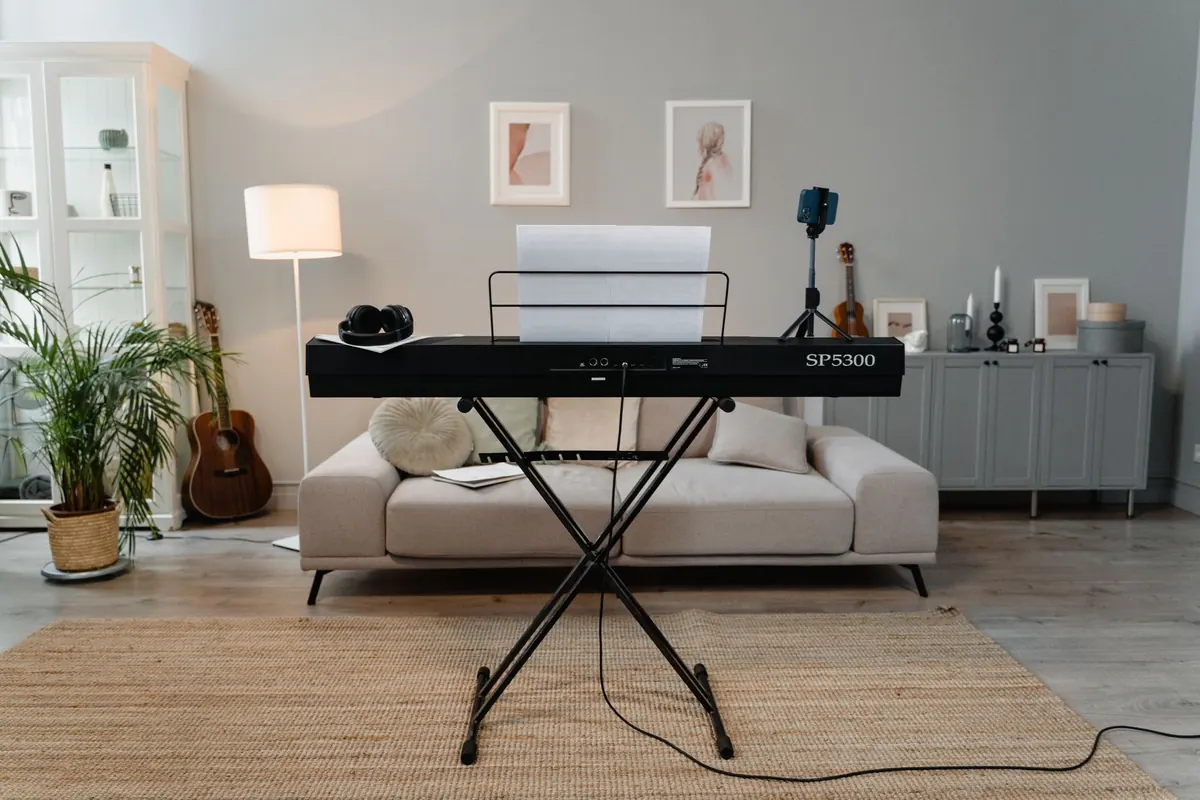
Photo: Tima Miroshnichenko / Pexels
Folding Music Stand Checklist: What to Test Before Rehearsal or a Gig
A practical pre-rehearsal and pre-gig check for folding music stands, covering joints, desk angle, feet,...

Back-to-School Practice Gear Checklist for Music Students
A practical, season-by-season checklist of the stand, folder, light, metronome, tuner, and bag a music...
About Us